Created by Zhanchao Yang
Source ↗
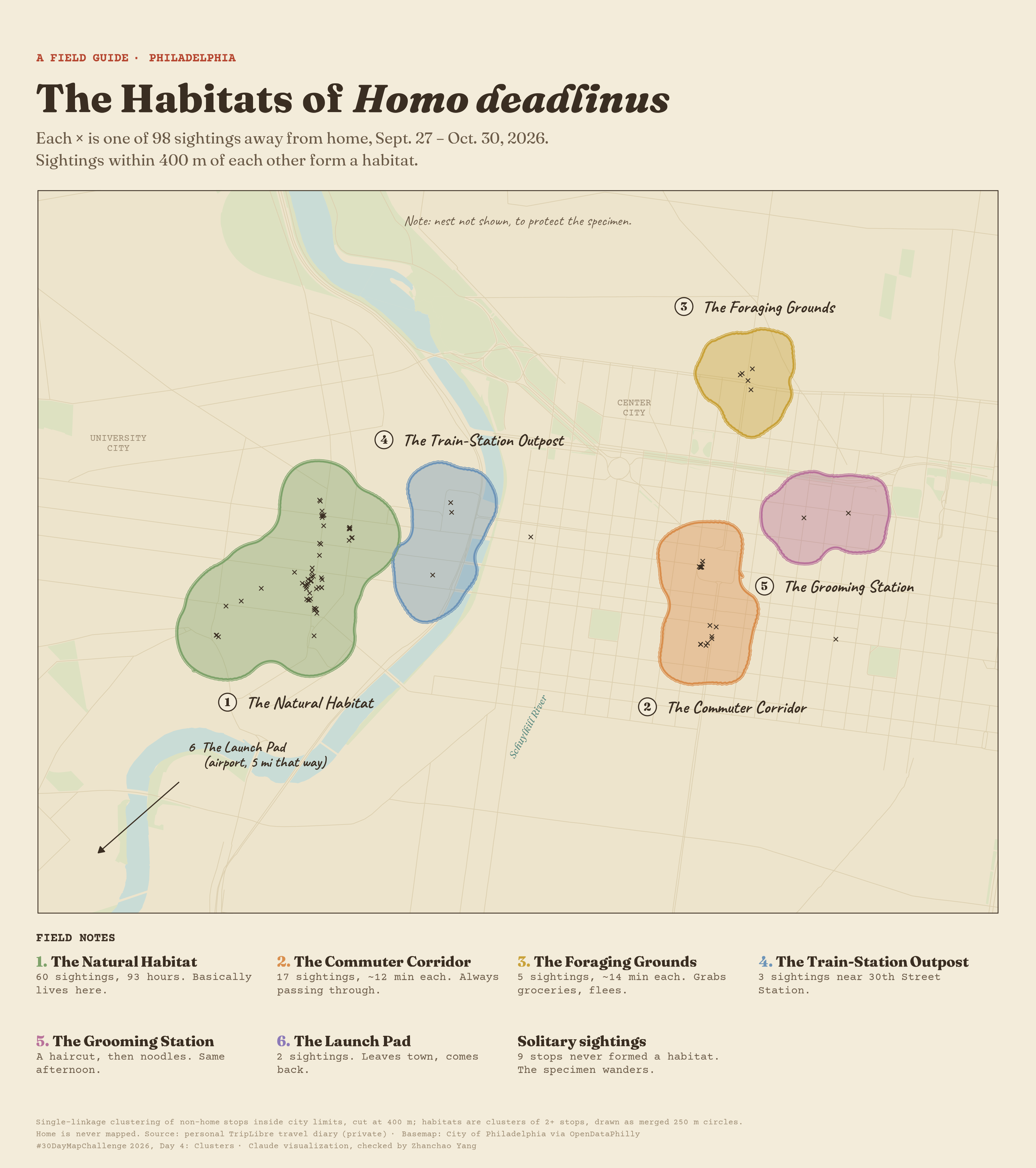
Day 4 (Clusters): For Day 4, I wrote up my TripLibre travel diary as a nature field guide to one grad-student specimen, Homo deadlinus. Each × is one of 98 sightings away from home in Philadelphia between Sept. 27 and Oct. 30, 2026. Sightings within 400 m of each other form a habitat. The jokes are the wrapper, but every number comes from the diary:
- The Natural Habitat on Penn’s campus has 60 sightings and 93 hours. Basically lives here.
- The Commuter Corridor has 17 quick sightings of about 12 minutes each.
- Smaller habitats are The Foraging Grounds (groceries), The Train-Station Outpost near 30th Street Station, The Grooming Station (a haircut, then noodles) and The Launch Pad at the airport.
- Nine solitary stops never formed a habitat.
Technical Implementation:
- R with
sf,dplyrandggplot2for clustering and mapping, with base Rhclustfor the clustering patchworkandggtextfor the map + field-notes layout and rich-text annotationsshowtextwith Fraunces, Courier Prime and Caveat for the field-guide typography- Method: single-linkage clustering of every non-home stop inside city limits, cut at 400 m, so stops chain into one cluster when each is within 400 m of another. A cluster with two or more stops is a habitat, drawn as merged 250 m circles that are rounded off and traced with a wobbly pen.
- Data: personal TripLibre travel diary export (visits & places). The raw data stays private. Home stops are dropped before clustering and never drawn.
- Basemap: streets, parks, hydrology and city limits from the City of Philadelphia via OpenDataPhilly