Day 11 (Senses: Sound): Where Sounds Ripple explores how the character “水” (water) is pronounced at Yue-related survey locations in Academia Sinica Xiaoxuetang’s phonology collection. Water patterns draw on the visual language of traditional East Asian water art, balancing approximate geography with an artistic composition.
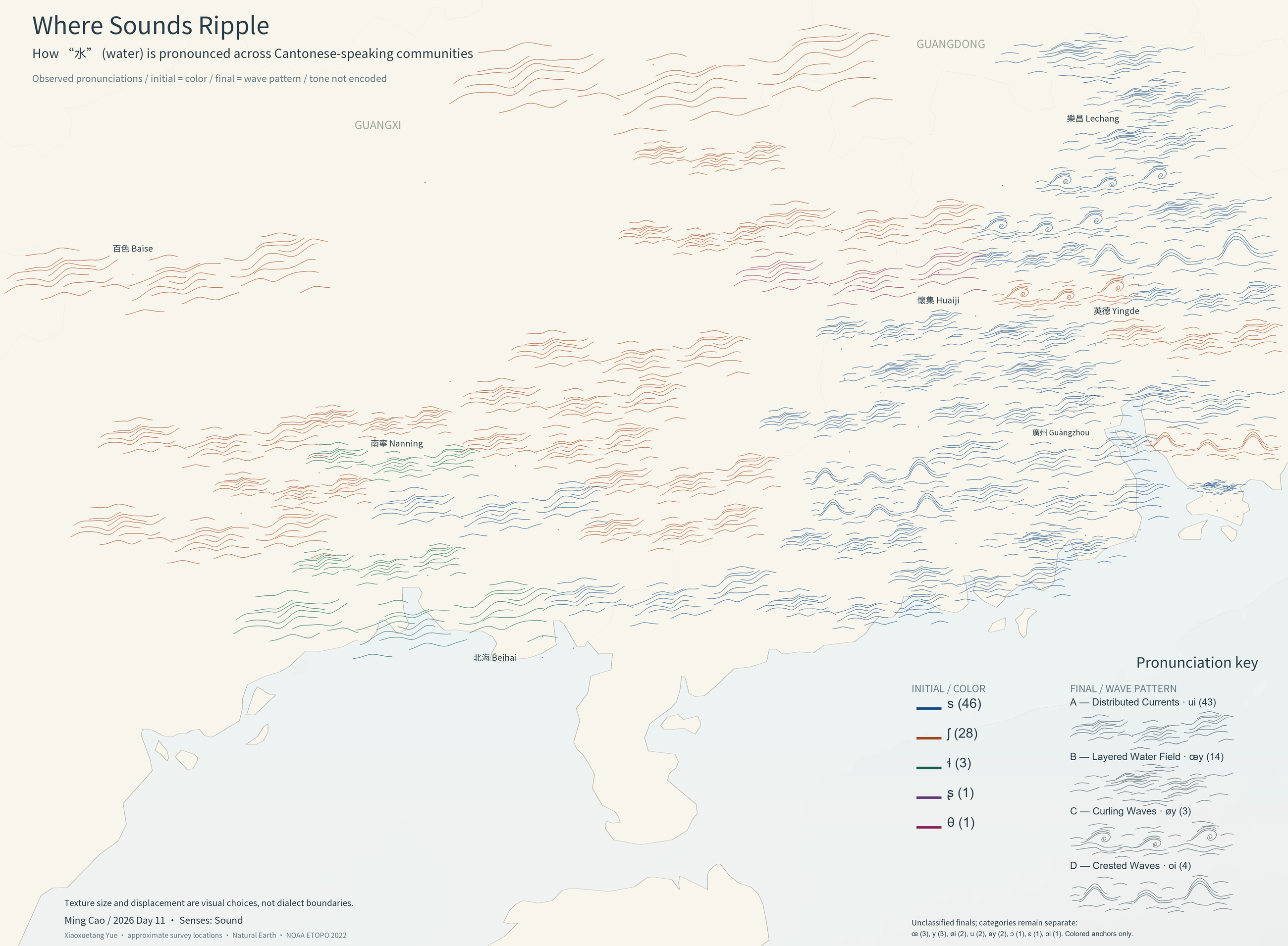
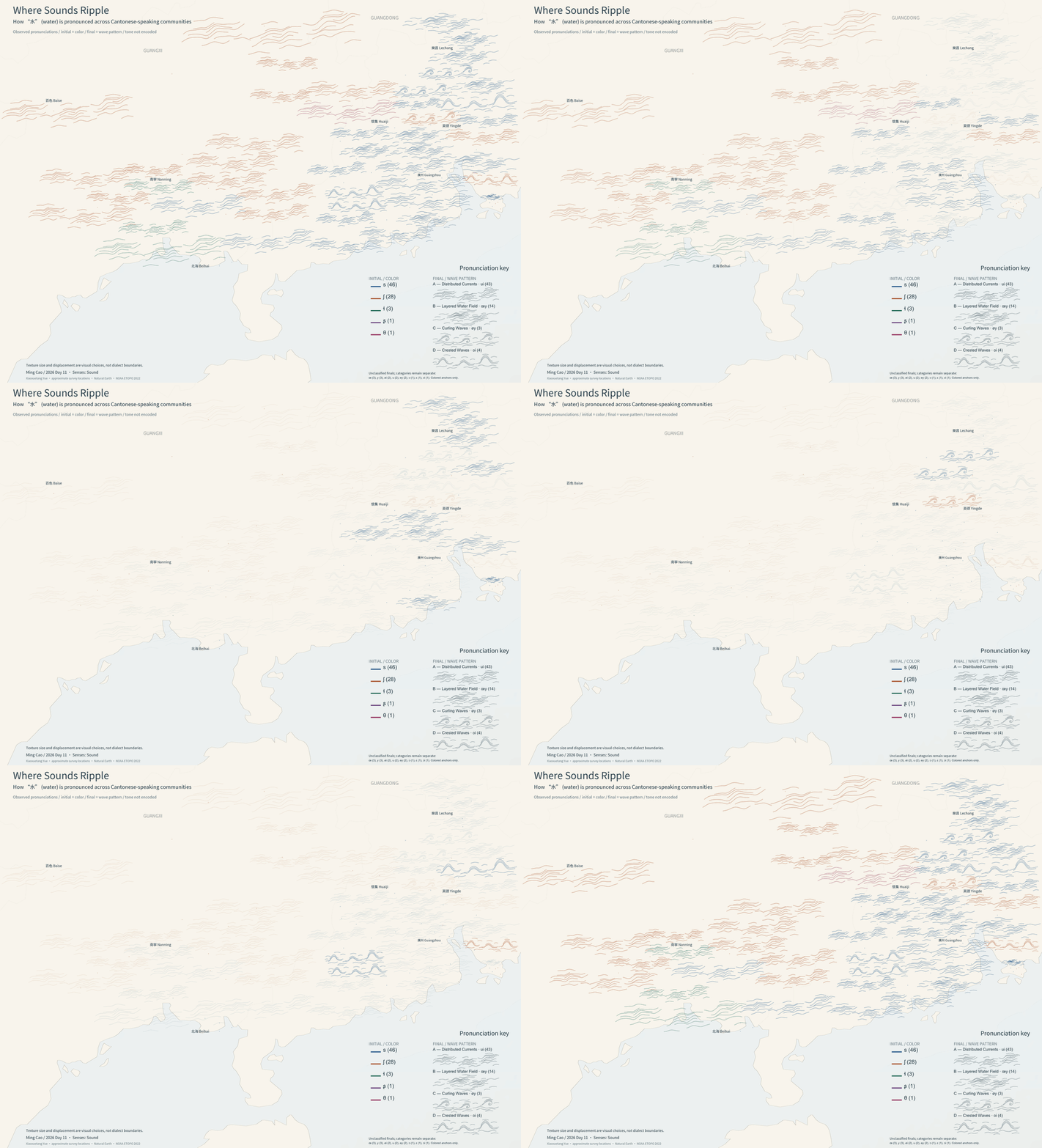
Color represents the recorded initial consonant. Four water-pattern types represent distinct original finals: Distributed Currents (ui), Layered Water Field (œy), Curling Waves (øy), and Crested Waves (oi). Eight other final categories remain separate, with in-frame observations shown as initial-colored anchors. Similar-looking transcriptions are not merged. Tone is retained in the data but is not encoded in the water patterns.
The animation highlights the four pattern types in turn:
The project retains 79 original records: 74 have approximate coordinates, 73 fall within the main frame, Bangkok lies outside it, and five remain unlocated. Within the frame, 48 water clusters represent 60 records; 13 others are anchor-only. Shared clusters combine nearby records only when their original initial and final match exactly. Locations may be town or county centers; textures are adjusted for readability. Their size and coverage do not represent dialect boundaries, population, phonetic distance, or actual sound waves. Blank space does not establish absence of a pronunciation.
Data sources:
- Academia Sinica Xiaoxuetang phonology downloads: retained Yue survey workbooks and saved survey-location links. Readings use the archived package consistently; source notation may vary, and file timestamps are not fieldwork dates.
- Geographic context: Natural Earth and NOAA ETOPO 2022, with generalized coastlines and bathymetry.